

Before You Order a Conference Table
Updated: Oct 28

In the spring of 2026 we built a conference table for U.S. Army Cadet Command at Fort Knox, Kentucky. Thirty feet long, five feet wide, Khaya mahogany. Then we loaded it up and drove it there ourselves. Eight hundred miles, five pedestals, four wire chases, and a rainstorm near the highest point on I-80 east of the Mississippi.
This is the other half. Everything we learned about ordering a table like it, in roughly the order people ask.
This is also a case study. Our goal with the post is to show you what goes into building a large conference table while sprinkling in a few entertaining anecdotes along the way.
Solid wood, veneer, or both?
Wait, what even is veneer?
Veneer sometimes gets a bad rap. Like, "what is that, plastic or something?"
It isn't. Veneer is real wood, sliced thin off a real log, usually around a fortieth of an inch. It gets glued down to a stable core. That core is the part that matters.
Here is why we used it. A solid top that long would move. Wood expands and contracts with the seasons, and the wider the piece the harder it fights you. Cupping, gaps, a split down the middle three winters from now.
The other reason is the grain. The leaves come off the log in order, like pages in a book. Lay them back in that order and the figure runs clean across the whole table, with no visible seams. You cannot do that with solid boards.
Two options for a table like this.
#1: All solid wood top. Solid boards glued together. The heaviest, the most expensive, and the one that moves most with the seasons, because that's what wood does.
None of that scares us off. We love solid wood, and it will build you a big table.
As of October 2026 we're finishing one: fifteen feet long, fifty-four inches wide, solid elm, two inches thick. Not plain boards either. The grain is wild and wavy, and they came out of several large slabs.
Solid wood is classic for a reason. It's an age-old building material, it's completely natural, and it has a lot going for it.
#2: Mix of solid wood and veneer. Not a sheet off a shelf. We pick the log ourselves, and the leaves get pressed onto an MDF core. The trade calls that laying up.
That forms the center of the table. Solid hardwood edges go on around it, and the edge profile gets cut into those. Solid where you touch it and see it, laid up where the span has to stay dead flat.
We'll tell you which one we would use for your room and why.
Picking the actual boards and veneer
For Fort Knox we were after ribbon figure, a shimmering grain pattern that catches light in a way plain-sawn boards don't. You can't order that off a list. Boards like these have to be hand-selected.
It took three suppliers to get the job done.
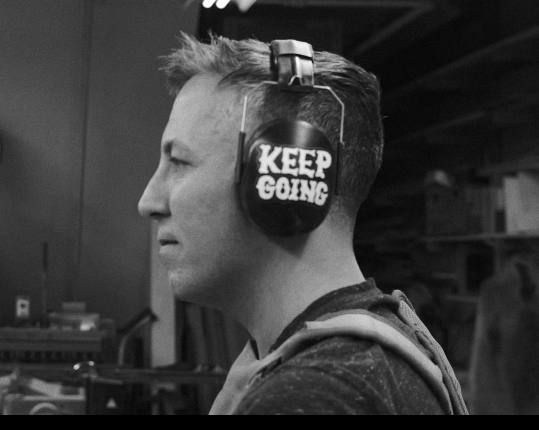
The first round came from Singh Hardwood Company in Far Rockaway, Queens. That's me in the video, up on the stacks, pulling mahogany down one board at a time. We bought every piece of ribbon mahogany they had, and it still wasn't enough. Buying the last ribbon mahogany out of a big lumber yard is the woodworking version of closing out a bar.


So we drove upstate to Ghent Wood Products and filled the van again, hand selecting as we went.
Then the veneer, from Certainly Wood. This is the part that keeps you up at night. The veneer field and the solid edges have to read as the same tree, and veneer is sliced from a different log than the boards sitting in your shop. We held samples against the lumber until we had a match, or as close to perfect as we could find.
The lay-up itself happened at Veneer One in Oceanside. That is what they do, and they did ours. It is also the step people forget when they ask why a table takes as long as it does, because not all of it happens in our shop.
Someone once said that ninety percent of success is showing up. We like to say:
Once you have a good design, 90 percent of success is choosing the right material.
Edge profiles
Don't sleep on these.
The edge is the part of the table people touch and lean on, and it does more to set the character of the piece than almost anything else. The same mahogany in two different profiles looks like two different tables.
Three basic options to start:
Eased edge. A simple roundover. Soft on the forearms, low-key, and hard to get wrong.
Cove. The traditional one. You've seen this profile in molding in older buildings and homes. Stately, elegant, and balanced.
Bevel. Minimalist and modern. A flat angled cut, crisp, no frills.
We're just scratching the surface, but these options are a good starting point for most projects. We have thousands of profiles on file, and we'll cut one that doesn't exist yet if you want it.


Finish
We like to offer two different options.
Lacquer. A hard film over the wood. If this room runs on hot coffee all day, lacquer is the sensible answer.
Odie's Oil. Natural, and tougher than people expect. One big advantage is that it's repairable and it feels silky smooth. If somebody drags something across it in year four, we can come and fix that spot. A lacquered top usually means refinishing the whole thing.
Either way, you choose.

Color
Colors are close to unlimited, which is exactly why we don't open with that.
We'll bring you a short list. Traditional brown mahogany, antique oak, American walnut. Most people find what they want in the first three.
If you need more choices, we go from there.
Don't stress about this part. It's supposed to be fun.
What about the base?
The Fort Knox conference table has five bases, each 28 by 24 inches, each with an access panel so the IT people can get underneath without crawling or unscrewing anything.
Ask who has to get under the table after it's installed, and how often. That answer shapes the base more than the look does.

Power and data
There are good options at every budget, from simple grommets and a wire chase to flip-up hubs with power, USB-C, HDMI and network at every seat. We'll walk you through a short list.
This one is genuinely yours to decide. It comes down to your budget and what your IT people need, and we'd rather show you three sensible choices than talk you into the expensive one.
What about wire chases?
The Fort Knox table had four of them.
If the term is new, a wire chase is a long rectangular box running under the table between the pedestals. Wires get run through the channel and rigged however the room needs.
Each box has a hinged door on a brass piano hinge, sitting in the center of the box rather than running end to end. A technician pushes it up, pulls it down, and has the wiring in front of them. No tools, nobody under the table on their back.
The clasp that holds the door shut against gravity is mahogany, cut from the same wood as the table.
Brass and mahogany, on parts of the table almost nobody will ever see. How you do one thing is how you do everything. The bottom should be beautiful too.
Four chases on a thirty foot table means a tech reaches any run from the nearest panel instead of fishing cable the length of the room.
How long does it take?
Eight to ten weeks, and sometimes longer for a large project.
Our standard turnaround on smaller pieces is six to eight weeks. A conference table runs longer because there is more material to find, more of it to match, and a veneer lay-up to schedule outside the shop.
We're not going to pretend otherwise to win the job. A table like this gets built once and then sits in your building for decades. Build it once, build it right.
What a conference table costs
As of October 2026, new conference tables typically start around $13,000 and go up from there. Size, species, construction, finish, power and delivery all move the number. Some simpler pieces can be less.
Best to give us a call to discuss, as each piece is unique after all.
How we work together
You pick the boards. You pick the edge profile. You pick the finish and the color. You pick the power hubs.
We show you drawings before anything is cut, so you see the table on paper first, and so does anyone you have to show it to.
During the process, we will send you pictures and video updates because we're cool like that.
Delivery day
Some aspects of delivery are, shall we say, unpredictable. Like when we woke up the morning of the delivery, somewhere outside of Columbus, Ohio, to ice on our windshield. This was somewhat surprising seeing as it was May 1st, and I'm glad I didn't put the ice scraper away for the season yet (you never know when it might come in handy).
Other things are entirely predictable, however. Many things that can go wrong on delivery day are knowable in week one. So, we ask early.
Here are some items on our checklist:
How we get in. Which door, what hours, is there a loading dock, where do we park, and any building management rules we should know about.
Elevator or freight elevator, and its real dimensions. A table designed around a seven-foot car is a different table than one designed around a five-foot car.
Steps, and how many. This one is critical and it's the one people forget. Even broken into pieces these tops are heavy. The step count decides how many people we bring and how we stage the whole day.
A video of the path. The single most useful thing you can send us, and it takes two minutes on your phone. Walk from where the truck parks to the room, filming as you go. Door, lobby, elevator, hallway, that corner. Send it early and we'll design the table so every component makes the trip and turns the corner.
Somewhere to work. A clean space with access to an outlet.
Someone from IT or facilities on site. Two reasons. We're not electricians and we don't do wiring, so if the table has power, somebody else makes the final connections. And more important, we need you to tell us exactly where the pedestals go. Centered for the camera, lined up with the floor outlets, whatever the room needs.
Tell us that before we start. A big table takes hours to assemble, and once it's together it doesn't slide. Moving it a foot means taking part of it back apart.
How far can Sound Designs deliver?
Within about three and a half hours of Glen Cove we deliver and set up ourselves. For a big job we'll go further, as Kentucky showed. Past that we crate it and send it with a white glove carrier anywhere in the continental US.
Although between you and us, we would rather drive.
How big can you go?
The largest we've built is thirty feet, and thirty feet is what fits inside our shop at Pratt Oval. Ten feet is where we start.
For something longer we bring in more hands and more space, which is how every shop handles a table that won't fit through its own door. Fifty foot tables get built. We haven't built one yet. We'd like to.

What types of wood do you use for conference tables?
We've talked about mahogany at length, because that is what Fort Knox called for. We would be remiss not to mention the American hardwoods we use just as often.
Walnut. The one most people picture when they say dark wood. Chocolate heartwood against pale sapwood, and you decide how much of that contrast ends up in the top. Walnut is the rare wood that lightens with age instead of darkening, settling into a warmer brown over the years. Softer than oak, so it marks a little more easily.
Cherry. Starts pale, almost pink, and darkens on its own. Give it a year of daylight and it turns a deep reddish brown. One thing worth knowing: leave a laptop in the same spot for the first six months and you will find a pale rectangle underneath it. It evens out eventually. Fine, even grain, and it takes a finish beautifully.
White oak. Hard, heavy, and water resistant in a way red oak is not, which is why it goes into boats and bourbon barrels. Quartersaw it and you get ray fleck, that tiger striping across the grain. Rift sawn gives you straight tight lines instead. It is the default for high-end work right now, and priced accordingly.
Can I see the shop?
We'd like that. We're at 40 Pratt Oval in Glen Cove, by appointment. Come stand next to the wood before you choose it. It's a different thing in person.




Comments