


We started Sound Designs by rescuing downed and fallen trees after storms. Each tree is different and each tree comes with a story.
We’ve recovered giant walnut logs from a health food store parking lot (long story), honey locust from a nature preserve, elm from a backyard, and other material in places we’d never have thought to look if we hadn’t driven by at just the right time.
Once we even left a note on a front door in Oyster Bay after the homeowner cut down a giant black willow on the front lawn. It was a beauty. We didn’t get that one. You win some, you lose some.
Have a downed tree? Send Us a Picture.
Send us a picture of the tree. That is the whole first step.
Add a couple of lines about the situation:
-
Tell us the location of the tree
-
Is it still standing, or is it already down?
-
When is it being removed?
-
Do you want something made out of the material?
That first one matters more than people expect. It can be the best tree we have ever seen, but if it’s in Michigan it might just be too far. Sorry, Michigan. We love you. It’s a long haul to Glen Cove.
We will take it from there and answer all of your questions. Sooner is better, since the best time to reach us is before the tree service starts cutting, but send the picture either way.
It seems complicated. It really isn’t. If the tree is worth salvaging, we will figure out the details.
The Details
What we look for.
Hardwoods, mainly black walnut, white oak, maple, cherry, ash and elm. A trunk at least twenty inches across and long enough to give us an eight-foot section. Sound wood, standing or recently down.
What usually doesn’t work.
Small trees, softwoods like white pine, and trees with serious defects.
The rest of this page is the long version: one tree, from the storm to the shop.
Sourcing a Backyard Tree
Sea Cliff, NY. Summer 2020. I still remember standing on line at the hardware store the day before the storm. I went for a few extra batteries and the line was out the door. There was a frenetic energy as customers grabbed whatever batteries and flashlights were left on the barren shelves. By the time I got to the aisle there were a few odd LED headlamps and an assortment of triple A batteries. Slim pickings. Tropical Storm Isaias was barreling up the coast, headed straight for Long Island, and we all knew it.
I remember lying in bed listening to the wind howl, thinking we were probably going to lose power. Miraculously, we didn’t. Many families on Long Island did, as trees came down and took the lines with them.
The morning after the storm I grabbed my phone to check Facebook and see what was going on. In the local groups the little red light popped up right away. A neighbor had tagged me on a post. “Are there any woodworkers interested in taking some of this material?” It showed a big walnut tree flat on the ground, its limbs through the homeowner’s fence, leaves and branches and walnuts scattered across the yard.
“Yes!”
It was an emphatic yes. I could tell from the picture this was probably the biggest black walnut we were likely to see for a long time. I was right.
Inspecting and Marking the Tree
The homeowner graciously let me come mark the tree. Equipped with orange ribbon and a measuring tape, I raced over.
The limbs sprawled across most of the yard. The tree had stood at the bottom of a hill at the far edge of the property and had uprooted in such a way that it fell back toward the hill. I climbed the trunk and wrapped tape around the main section where the tree forked.
That fork is what I came for. Where a tree splits, the grain has to turn, and it crowds and swirls instead of running straight. That’s the feathering and figure you see in a crotch slab, and you can’t get it from a straight log.
I couldn’t be sure the tree would yield good slabs, but I had a hunch from the condition of the trunk and the health of the bark. From there I marked as many ten and eleven foot sections as I could and hit the road.
Finding a Tree Service
The next day I talked it through with the homeowner. She covered the cost of taking the tree down and hauling the debris. I covered the extra the tree service charged to separate out the logs I wanted and get them to the sawmill in East Setauket.
Fortunately I knew a good tree service in town. Reasonably priced, and familiar with my process.
We were off to the races.
Cutting the Tree Into Sections
Mark owned Steiert Landscape Service, the tree service in town. He’s retired now. He showed up the next morning with a small crew and a cherry picker on the truck.
The tree had come down at the far edge of the property, but there was a parking lot next to the house, and from the lot they could reach the whole thing. They set up there.
Up went the bucket. They took the crown first, cutting the branches off the top and working their way down slowly, stopping only to toss the limbs into the woodchipper. A fallen tree still has to come apart from the top down. The crown lands in a pile under its own weight, and until that’s cleared nobody can get near the trunk.
Then the part that decides everything, and it takes about twenty minutes.
A crew clearing storm damage is paid to make a tree disappear. Left alone, they cut the trunk into rounds light enough to roll, and a furniture tree becomes firewood before the coffee is cold. That’s why I called Mark. He knew what the tape meant. We cut at the tape, and we cut a few inches long on purpose, because the end of a fresh log checks and splits as it dries and those inches come off later anyway.
By the end of the day the yard was clear. The limbs were chipped, the fence line was open, and the logs I wanted were headed for the tree service’s yard. The homeowner got her property back and went on to restore it.
She paid for a removal she was going to pay for anyway. I paid a few hundred dollars more and got the tree.
That is still how it works.
Getting the Logs to the Mill
The logs went to the tree service’s yard in Glen Cove. They were supposed to sit a few weeks and then hitch a ride out east to the mill. The yard was slammed with storm work and didn’t have a truck to spare.
Which started a clock I wasn’t happy about.
Wood dries from the ends first. End grain is open, like a bundle of straws, and water leaves there many times faster than it does through the bark. In August it leaves fast enough that a fresh log can start to check, which is the lumber term for the splits that open along the grain, within days. Sometimes within hours. Every one of those splits is a line through a future table.
So the morning after the tree came down I raced over to the yard with a bucket of AnchorSeal. It’s a waxy coating you brush onto the end grain, and all it does is slow the drying down to the rate the rest of the log is drying at. That’s the whole trick. Even drying is what keeps wood together.
I could see faint cracks already starting on a couple of the ends as I worked. Nothing major. The logs were still the best thing I’d ever had my hands on.
Several weeks later the tree service ran them out east for me. A few hundred dollars, port to port, as they say. They dumped them in a pile right next to the mill.
Those weeks of waiting cost me nothing, and the only reason is the sealed ends. That bucket of wax bought the whole delay.

Steiert Landscape Service yard, Glen Cove, August 2020
Steve the Sawyer
Steve Carolan runs Terrapin Sawmill. We call him Steve the Sawyer.
His yard back then, before he moved to the site he is on now, sat next to a firewood processing operation, which tells you most of what you need to know about where storm wood usually ends up. The first thing that greets you there is a golden retriever. On nice days he naps in the bed of Steve’s truck on a pad while Steve works, and he meets visitors with a toy in his mouth, or with both front paws.
Steve looked at the logs and agreed they were something. He put them in the queue.
The queue was long. That same storm had put a bumper crop on the ground out east and Steve was hired to mill a good deal of it. It would be several months before he got to mine.
That turned out to be luck. Wood that starts drying in January dries far slower than wood that starts in August, and slow is what you want. Slower drying means fewer checks, fewer cracks, fewer of the defects that turn a slab into firewood. Waiting until winter was better than anything I could have planned.
It eased my mind.

Steve the Sawyer at Terrapin Sawmill, June 2026
Milling
The main trunk measured over 54 inches across at the fork.
That’s wider than the mill will cut. The sides had to come down slightly just to get it to pass. Fifty-four inch walnut is not something you come across in a backyard, or anywhere else.
We cut the trunk through and through, which means every slab came off the log in order and stacked back up in sequence, so two slabs that were neighbors in the tree are still neighbors in a finished table. Steve cut them at a hair under three inches. Call it 2 7/8.
The big log gave us seven slabs. The rest of the tree gave maybe thirty more. I never counted them all.
Yard trees also carry hardware. Clothesline hooks, fence staples, the nails from a tree house somebody built in 1974, all of it grown over and invisible. A hidden nail will wreck a sawmill blade, so the logs get looked over before they go in.

The crotch slab from the fork, right off the mill
Stacked in the Catskills
Steve milled them in January 2021.
We stacked them on January 23, 2021. It was about twenty degrees. The sun was out when we pulled into the property in the Catskills, and the work was the only thing keeping us warm. The slabs came off the van damp and heavy enough that you plan every lift before you make it.

Fresh off the mill, January 2021
We hired two guys from the neighborhood to help get them off the van and onto the platforms, which are oversized on purpose. Many hands make light work, supposedly. These stayed heavy.
My friend Joe Falco was up there with me. He has been around since before this was a business, back when it was only an idea, and he earned every penny that day.

Joe Falco with the finished stack, January 2021
They went up there because we knew we wanted to take our time.
The rule is a year of air drying for every inch of thickness. At 2 7/8 inches that’s three years before the wood is ready for anything.
Here’s how a stack gets built.
The slabs go back up in the order they came off the log, so the tree reassembles itself on the platform and takes its old shape again, only with gaps now. Those gaps come from stickers, thin sticks about an inch square laid between every layer. Without them the moisture has nowhere to go. Air moving through those gaps is the entire mechanism. The water wicks out of the wood and the wind carries it off, and that is all drying is.
The platform holds the stack about 16 inches off the ground, high enough that snow, ice, and rain splashing up off the dirt stay off the bottom slab.
The top of each stack is the wane cuts, the first pieces off the log, bark still on and half round like a dome. They become the roof. They take the rain, the snow, and the direct sun so the good slabs underneath don’t have to. Nothing gets bought for this. The tree brings its own cover.
Then we strapped each stack down with heavy duty ratchet straps rated at 1,500 pounds, the kind meant to hold a load on a truck.
By the end of that day our toes were cold, our muscles were sore, and the sun was setting.
Winter was beginning to loosen its grip. You could feel that the days were getting longer.
We drove home full of optimism. We didn’t know what would become of this wood. We just knew it was going to be something.

The top of the big stack in the Catskills
Wood moves while it dries. It cups, it twists, it tries to go somewhere. The straps are what keep it from going. It is family land and we go up anyway, so for the next several years every visit included a walk down to the stacks and a turn on every ratchet.
That’s the part nobody puts in a brochure. Five years of tightening straps on a woodpile.
We don’t have to go that far anymore. We can stack and dry at Pratt Oval now, and production has moved there, so a tree that comes down in Glen Cove can do its waiting a few miles from where it fell.

Inspecting the walnut, summer 2023
Kiln Drying
Air drying alone gets wood close. It doesn’t get it to furniture, and it doesn’t deal with what’s living in it.
So every slab we use goes through a kiln, which means loading them up and driving them to Ghent, to an operation set up for slabs this wide. The kiln takes the moisture down to the six to eight percent range, which is roughly what the inside of your house sits at, and holds the wood at a temperature high enough to kill any insects and larvae in it. That last part matters more than people expect. Wood that skips the kiln can bring powderpost beetles into a house, and they don’t stay in the table.

The walnut at Ghent Wood Products, April 14, 2026


Six Years Later
The stacks came apart in April 2026.
The rule said three years. We air dried for five.
The honest version is that I was busy with other projects and the wood kept. That is part of why I like this material. If you have other irons in the fire, and we have had plenty, it’s good to have some in reserve.
Walnut does benefit from drying slowly. Some will tell you a much shorter air dry is fine, and they’re right, it can be. But if you’re not in a rush we think the slow way gives the best results. In the end that is for the customer to decide.
What came out was dry and flat.
Flat is the word that matters. No cup, no twist, no warp, and almost none of the checking and splitting that ruins a slab while it dries. Low and slow is what does that, and this wood got more of it than the rule asks for.
They came out in sequence too, every slab where it was in the tree. The biggest of them stands taller than I do.
A homeowner in Sea Cliff lost a walnut in a storm, and nearly six years later it’s in the shop in Glen Cove, waiting on the right room.
Sometimes It Doesn’t Work
A few weeks before I sat down to write this, my phone rang. A homeowner in Plainview had found us in a Google search and wanted to know if we could salvage a dead standing black locust.
He texted a picture. It didn’t do the tree justice, so we set up a site visit.
The trunk was big. Thirty-six inches across the middle, which would have given us slabs as wide as almost anything we own.
But there were telltale signs of trouble, and the worst of them was a fresh crop of mushrooms coming up out of the fork. The fork is the first place I look on any tree. On the Sea Cliff walnut it was the prize. Here it was the warning. Mushrooms are the tree telling you what is going on inside it, and the news is never good.
Sure enough. The tree service dropped it and texted me a picture of the butt end. I didn’t need to be standing there to read it. A void ran right up the middle, and the crew put it at more than five feet into an eight foot log.
When that much decay shows on the face, there is no telling what is waiting further in. That is expensive firewood.
We passed. Not worth milling, at least not for what we do.
Thirty-six inches, though. That one could have been a contender.
You win some, you lose some, as my old boss used to say.
That is the right attitude, because you don’t know what you have until the tree is down and cut into logs. You take the chance. There is risk in it.
But isn’t that the beauty of the whole thing?
The Sea Cliff Walnut
In August 2020, Tropical Storm Isaias knocked down a big black walnut in a Sea Cliff backyard. The next morning a neighbor tagged me in a Facebook post. I could tell from the picture it was probably the biggest black walnut we were likely to see for a long time. I was right.
54 inches across at the fork. Wider than the mill will cut.
Mark at Steiert Landscape Service cut the logs to our lengths. The homeowner paid for the removal she needed anyway. We paid a few hundred dollars more and got the tree.
We sealed the log ends the next morning so they wouldn’t split while they waited for the mill.
Steve Carolan at Terrapin Sawmill cut it through and through at 2 7/8 inches. Seven slabs from the big log, maybe thirty more from the rest.
Five years of air drying, then the kiln in Ghent, down to 6 to 8 percent moisture.
The slabs came out dry, flat and in sequence. The biggest stands taller than I do.
Nearly six years later it’s in the shop in Glen Cove, waiting on the right room.

Making the first cuts on a 14-foot slab of white oak before it went into the shop in Glen Cove. More in Behind the Hedges: Giving Wood a Second Life.
Maybe you have a tree that is coming down or that has already fallen down due to a storm. If you’d like us to work with you to recover it, here’s a quick checklist on what we need to know:
-
What kind of tree is it?
-
How big is it (ballpark is fine)?
-
Where the tree is located
-
Is it still standing, or is it already down?
-
When is it being removed?
It can be the best tree we have ever seen, but if it’s in Michigan it might just be too far. Sorry, Michigan. We love you but it’s a long haul to Glen Cove. It might also be too difficult to remove large sections in a small backyard.
If the tree is worth salvaging, we will figure out the details.
How the cost works.
You pay your tree service for the removal, the same as you would anyway. We cover the added cost of cutting the logs to our lengths and getting them to the mill. If you want a piece made from your own tree, we’ll talk about that separately.

A black locust in Plainview. Big, but hollow in the middle. We had to pass on this one.

SERVICE
We Deliver
White glove delivery across Long Island, New York City, Westchester, and beyond. For the right project, we travel nationwide. We’ve done Kentucky: a 30-foot conference table for the US Army at Fort Knox. Long Island Press covered the trip.


Trees and What They Became
A honey locust that fell across a trail at a North Shore arboretum in the March 2018 storms is now the La Selva coffee table in Southampton.
An elm the power company took down a few blocks from our shop in January 2020 is a console table in Pound Ridge.
A backyard cherry tree from Stony Brook became floating shelves in a Hamptons kitchen.
Walnut boards recovered from an estate in Matinecock were used to construct Salutations Sideboard.
Ultra rare katsura tree became a dining table for a client in the Berkshires.
And last, but certainly not least, a walnut tree recovered from a construction site right here in Glen Cove became a dining table for a client in North Merrick.


PROJECT GALLERY
SELECTED PROJECTS
Salvaged Wood Furniture, Long Island
Every log goes to Steve Carolan at Terrapin Sawmill in Setauket. The slabs air dry, then get kiln dried. Then we build in our shop in the Pratt Oval building in Glen Cove.
Not every slab is local. When clients want a species or size we don’t have, we buy from mills in Pennsylvania or in Upstate New York. We’ll always tell you which is which.
OUR TREES
Honey locust
Elm
Cherry
Black Walnut
Katsura
Black Locust
Hickory
Ash
The Sea Cliff Walnut

Marking the tree with orange ribbon, Sea Cliff, August 2020

Mark Steiert’s crew taking the tree down, August 2020

The logs at the Steiert Landscape Service yard, Glen Cove, August 2020
Steve the Sawyer at Terrapin Sawmill in Setauket. He milled the walnut in January 2021. Video from our visit, June 2026.

The crotch slab from the fork, right off the mill, January 2021

Fresh off the mill, January 2021
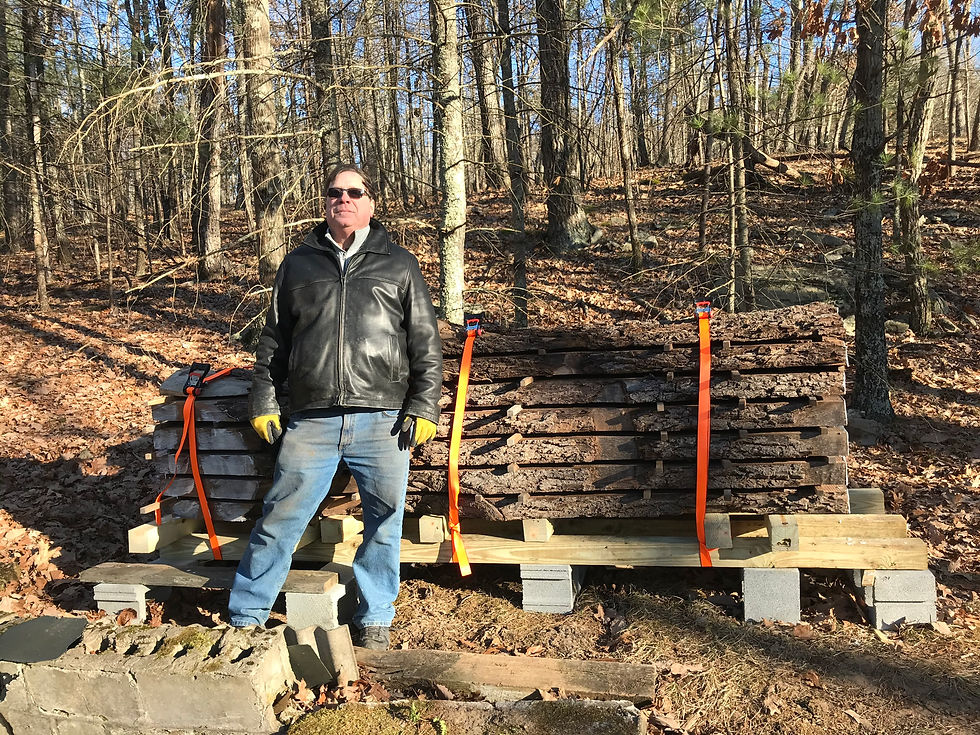
Joe Falco with the finished stack, January 2021. Joe helped get Sound Designs off the ground in the early days, when it was all still an idea.

The top of the big stack, air drying

The Sea Cliff walnut, stacked and strapped in the woods

Joe Ferrara, founder of Sound Designs, inspects the walnut, summer 2023

The walnut at Ghent Wood Products, April 2026

At the kiln in Ghent, April 2026

Kiln dried down to 6 to 8 percent moisture
Honey Locust, Walnut and Elm
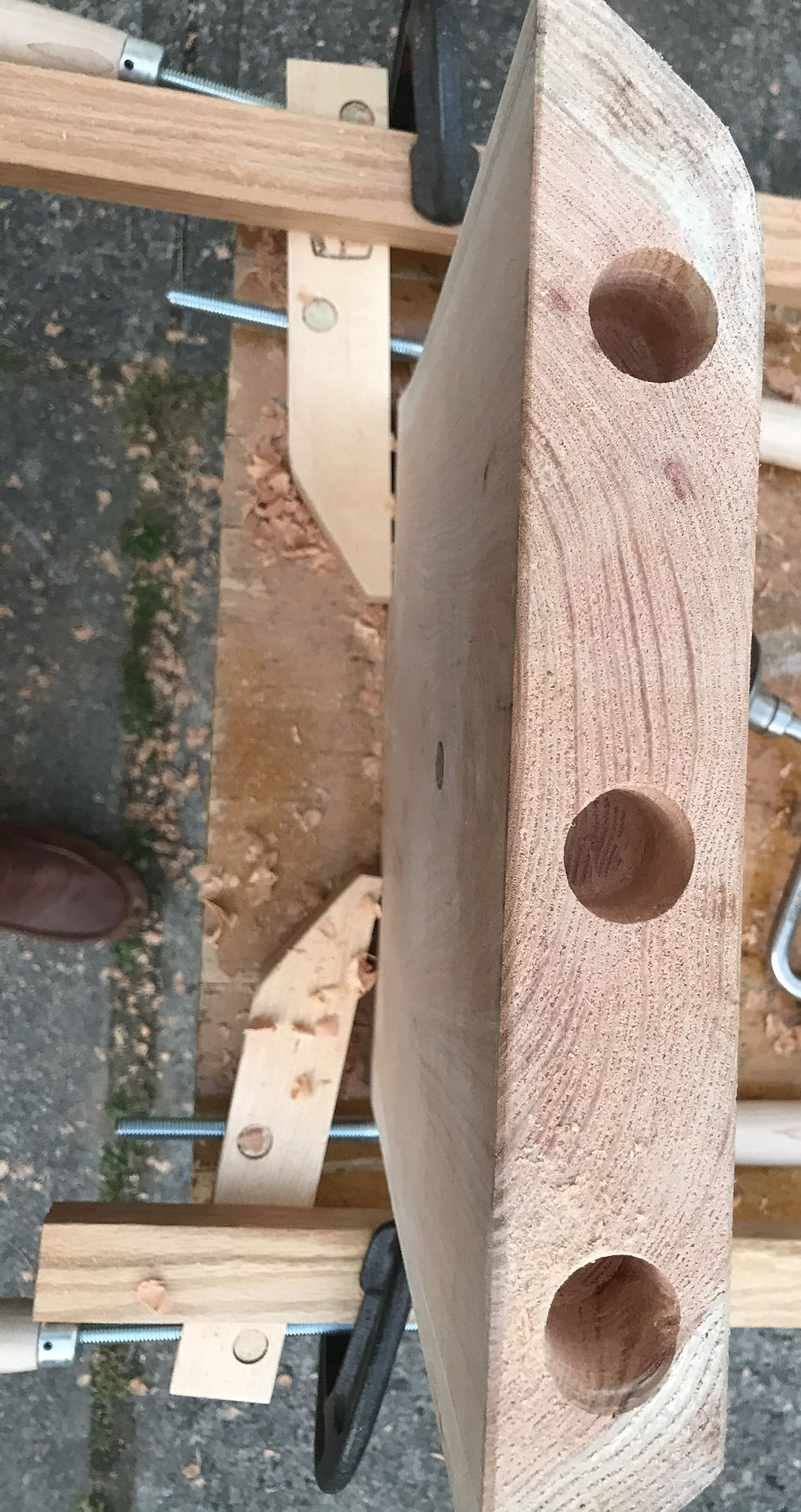
Honey locust in the shop

A large honey locust dining table with steel legs

The same table, in Nyack

A walnut log at a construction site in Glen Cove

Moving it out of the Glen Cove site

The same walnut, now a live edge table in North Merrick, 2026

Elm that became a coffee table